FAQ
Questions clinics ask us first
Short, direct answers on residency, pilots, standards and language support. If something is missing, ask us.
- What stage is NovaMed at today?
- Pre-commercial and validation-first. The system sits at an early readiness stage; the goal is a validated prototype used by real patients and clinicians in a real clinic under ethics approval. We describe what we've proven and what we haven't, plainly.
- Is NovaMed certified or approved?
- No. Our standards work — Health Canada Class II SaMD pathway, ISO 13485, IEC 62304, ISO 14971 — is in progress. We present these as pathways, not as issued approvals or endorsements.
- What does a pilot involve?
- A scoped, time-boxed evaluation with a defined clinical workflow, an agreed set of measures, training for staff, and a written summary at the end. Pilots run under the applicable research or quality-improvement pathway for your organisation.
- Who is a pilot for?
- BC clinics, primary-care networks, health authorities and partner organisations exploring maternal or clinic-to-home monitoring workflows.
- What does a pilot cost?
- Pilots are physician-led and unbilled — there's no per-patient charge during the evaluation. Paid arrangements (site licence, implementation, subscriptions) come later, only if a site chooses to convert after the pilot.
- How do we start a conversation?
- Use the contact form, the partners pilot-interest form, or email info@novamedsystems.ca. We reply from Vancouver during business hours.
- Is NovaPatch Vital available today?
- No. NovaPatch Vital is in development and is not offered for sale or clinical use.
- Do the devices in the NovaMama kit need to be certified?
- Yes. NovaMama uses certified OEM peripherals — blood pressure, SpO₂ and weight devices from established suppliers — sourced under current safety and radio certifications. NovaMed builds the integration layer around them; we don't manufacture the hardware.
- Can we use our own devices instead of the NovaMed kit?
- That's the intent of the design. An OEM-agnostic device-abstraction layer means the platform isn't locked to one vendor's peripherals, so certified devices can be substituted without changing the platform. Specific device support is confirmed case by case.
- Is the patient app accessible and usable on limited connections?
- It's designed bilingual, low-bandwidth and culturally-attuned by intent, with guided readings and adherence prompts — so it's meant to work for a wide range of patients and network conditions.
- Where is data stored?
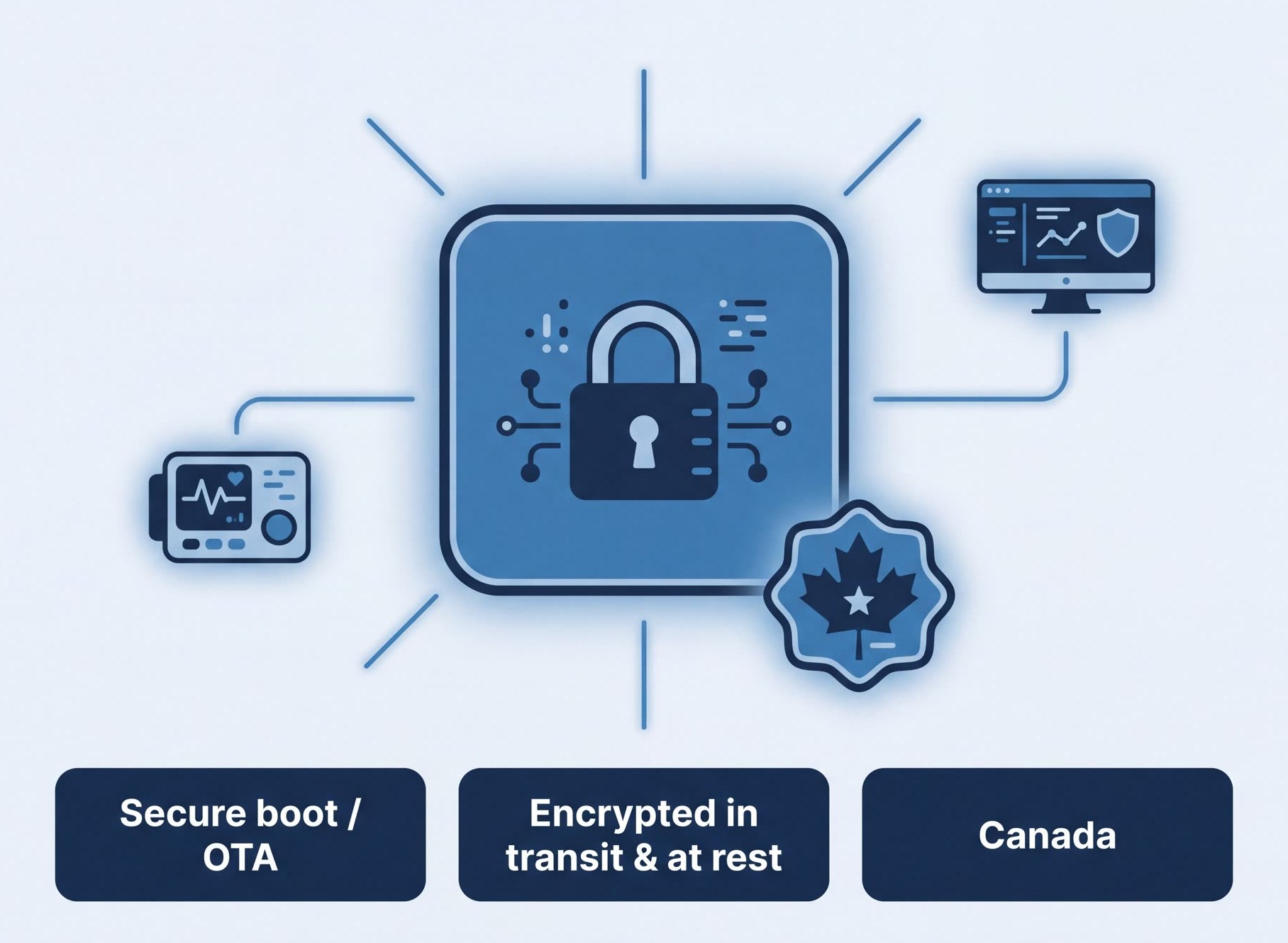
- NovaHub Care is designed for Canadian data residency: production data stays in Canadian regions, with role-based access, audit logging and encryption in transit and at rest. This marketing website itself collects only the information you type into a form.
- Who owns the patient data, and can it be deleted?
- The clinic or health organisation remains the custodian of its patients' data. Data is held in Canadian regions with least-privilege access and audit logging, governed by a data-sharing agreement that sets out retention and deletion.
- How is patient consent handled?
- Consent is captured as part of the workflow and logged. Pilots proceed only under the applicable research-ethics or quality-improvement pathway for your organisation, with physician oversight.
- Who is responsible for clinical decisions and alerts?
- Clinicians are, always. The platform surfaces readings and flags thresholds a clinician can read, with clear escalation — it supports clinical judgment and does not make diagnoses or act on its own.
- Which EMRs do you integrate with?
- The platform is designed around FHIR and HL7 so it can exchange data with existing clinical systems. Integration with any specific EMR is scoped and confirmed per site rather than promised in advance.
- How do you handle interoperability?
- The platform is designed around FHIR and HL7 concepts so information can be exchanged with existing clinical systems rather than sitting in a silo.
- Do you support English and French?
- The platform and this site are built bilingual by design. English content is live today; French is being prepared, and the structure is already in place.
- What kind of support do clinics get?
- Implementation includes structured onboarding, role-based staff training and EMR setup, with ongoing platform support and analytics/reporting. Scope is agreed per site.